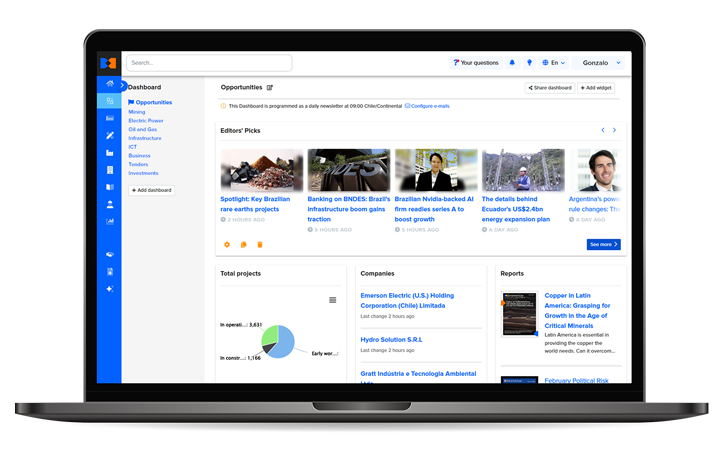
We are Latin America’s leading business intelligence platform
With 30 years of experience, we provide data-driven strategic insights to help you access new business opportunities, make informed decisions, and stay ahead of key market trends.




























Discover the tools that provide critical business intelligence and market insights

Projects
Track major projects in your industry and identify key investment opportunities.


Companies
Analyze competitors and potential clients with updated data and key insights.

Contacts
Connect with key executives and decision-makers across various industries.

News
Access up-to-date data and analysis on the region, curated by on-the-ground experts.

Forecast
Get early insights on future projects in Latin America to plan ahead effectively.

Reports
Access detailed market reports to predict trends and make informed business decisions.

Factiva
Stay informed with real-time news from over 3,100 trusted sources worldwide.

Custom Files
Request updated data on projects, companies, or contacts in your preferred format.

Datasets
Access historical and real-time industry data for strategic analysis and decision-making.
Projects
Track major projects in your industry and identify key investment opportunities.
Companies
Analyze competitors and potential clients with updated data and key insights.
Contacts
Connect with key executives and decision-makers across various industries.
News
Access up-to-date data and analysis on the region, curated by on-the-ground experts.
Forecast
Get early insights on future projects in Latin America to plan ahead effectively.
Reports
Access detailed market reports to predict trends and make informed business decisions.
Factiva
Stay informed with real-time news from over 3,100 trusted sources worldwide.
Custom Files
Request updated data on projects, companies, or contacts in your preferred format.
Datasets
Access historical and real-time industry data for strategic analysis and decision-making.
Who is BNamericas for?
Explore how our platform helps different sectors make strategic decisions with reliable data and business analysis in Latin America.
Contractors
Discover business opportunities in strategic projects, minimize risks, and access key data for planning and bidding.
Providers
Connect with projects needing your products, identify opportunities, and optimize lead generation with industry contacts.
Owners & Operators
Evaluate investments, optimize asset management, identify opportunities, and analyze projects with key market data.
Consultants
Access market intelligence and strategic reports for accurate guidance and real-time industry analysis.
Financial Services
Identify financing opportunities, access economic projections, and improve risk assessment with reliable financial data.
Legal Services
Stay ahead of regulatory changes, access up-to-date legal information, and provide strategic advisory with detailed analysis.
Government
Explore public and private investment opportunities, analyze trends, and get critical data on regional regulations and policies.
Insurance
Review risks in key projects, gain industry intelligence, and connect with businesses needing strategic insurance solutions.
Contractors
Discover business opportunities in strategic projects, minimize risks, and access key data for planning and bidding.
Providers
Connect with projects needing your products, identify opportunities, and optimize lead generation with industry contacts.
Owners & Operators
Evaluate investments, optimize asset management, identify opportunities, and analyze projects with key market data.
Consultants
Access market intelligence and strategic reports for accurate guidance and real-time industry analysis.
Financial Services
Identify financing opportunities, access economic projections, and improve risk assessment with reliable financial data.
Legal Services
Stay ahead of regulatory changes, access up-to-date legal information, and provide strategic advisory with detailed analysis.
Government
Explore public and private investment opportunities, analyze trends, and get critical data on regional regulations and policies.
Insurance
Review risks in key projects, gain industry intelligence, and connect with businesses needing strategic insurance solutions.
Business Intelligence for Latin America’s Key Industries
Electric Power
Track industry trends and project details in solar, wind, hydro, and thermal energy.
Explore Electric Power Explore Electric Power Explore Electric PowerFinancial Services
Stay informed on banking trends, insurance markets, and financial regulations.
Explore Financial Services Explore Financial Services Explore Financial ServicesICT
Analyze digital transformation trends shaping industries in Latin America.
Explore ICT Explore ICT Explore ICTInfrastructure
Access insights on public and private investment plans and regulations.
Explore Infrastructure Explore Infrastructure Explore InfrastructureMining & Metals
Track commodity prices, industry trends, and investment opportunities.
Explore Mining & Metals Explore Mining & Metals Explore Mining & MetalsOil & Gas
Stay updated on investment trends, regulatory changes, and price fluctuations.
Explore Oil & Gas Explore Oil & Gas Explore Oil & GasPetrochemicals
Monitor industry competition, legislative updates, and emerging trends.
Explore Petrochemicals Explore Petrochemicals Explore PetrochemicalsWater & Waste
Follow regulatory updates, industry risks, and treatment innovations.
Explore Water & Waste Explore Water & Waste Explore Water & WasteDaily industry intelligence and real-time insights for informed decision-making
Expert-driven market data, enhanced with AI, for smarter business decisions.
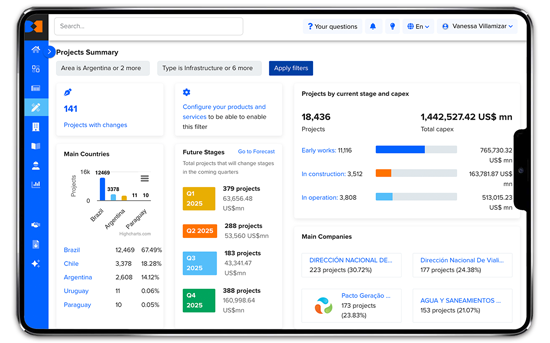
Accurate data and clear insights
Access updated information and detailed analysis that will help you anticipate market trends and achieve your business goals.
Trusted by industry leaders
See how companies grow with our market intelligence.
 ”I have relied on the business news and industry insight provided by BNamericas since its inception, and I have no hesitation in recommending a subscription to BNamericas as I am sure it will help you identify prospects and grow your business, as it has done for us”
 “Every morning BNamericas is my first source for news; it provides me with a complete view of the Latam energy and infrastructure sectors in the most efficient matter”
 ”Our team has greatly benefited from our subscription to BNamericas, partly due to its unique breadth across various industry sectors”
 “BNamericas has become a valued business partner for our firm over the years. Not only delivering relevant information and data but understanding and delivering insights on changes in the industry and the market”
 “BNamericas is an unique source of strategic information for the infrastructure industry in Latin America, covering political trends, regulatory issues, upcoming tenders, etc. in a very friendly platform. No matter if you are policy maker, a sponsor, a financier or a specialist, having BNamericas in your daily breakfast menu will keep you connected to all important facts of the region”
 “I trust BNamericas for my information needs in Latin America and the Caribbean. BNamericas has built an impressive database and a powerful search engine that makes research in any energy subject a breeze”